NetEdison Community
EnergyNet becomes a lived, local service through Communal Parks and not-for-profit Community Utilities — the human layer that carries an open electricity standard from a technical protocol into a place people actually use.
Talks, colloquia, and community gatherings where the NetEdison community-energy model is presented and discussed.
Lane Sharman, President of Open Doors Management, presents on Community Choice Aggregation under U.S. state law — its successes, challenges, and shortfalls — drawing on two decades of renewable energy development, the formation of the Solana Energy Alliance (San Diego's first Community Choice Aggregation, through which Solana Beach reached 100% carbon-neutral electricity in 2020), and the Move Now coalition building small-scale solar and storage projects across the U.S.
The talk is followed by an audience Q&A moderated by Sebastian Schwarz, Chief Engineer at the Institute for Automation of Complex Power Systems. Hosted by FEIN e.V. at the E.ON Energy Research Center, RWTH Aachen — Rooms 00.26/00.27, Mathieustraße 10, 52074 Aachen — with remote participation via Zoom.
Open Doors organizes community development around a fixed sequence: shared infrastructure first, a public park second, and individual buildings last. NetEdison Communities applies this discipline to every deployment — new-build or existing neighborhood — so residents experience the network before they are asked to commit to it.
Water, thermal, power, DC routing, fiber, mobility, and waste systems are established before individual parcels are built out or renovated — the same underground and overhead capacity every later building will draw on.
A public landscape and civic utility room that makes the shared infrastructure visible, usable, and trusted. It is the point at which residents first experience the benefit of the underlying network.
Homes, workspaces, and shops connect last, as voluntary participants in a system whose capacity, rules, and civic purpose already exist — in both new communities and old ones being renewed street by street.
A Communal Park is a public amenity and a functioning node of the NetEdison network at once — a concrete anchor for generation, load, and revenue ahead of full residential buildout.
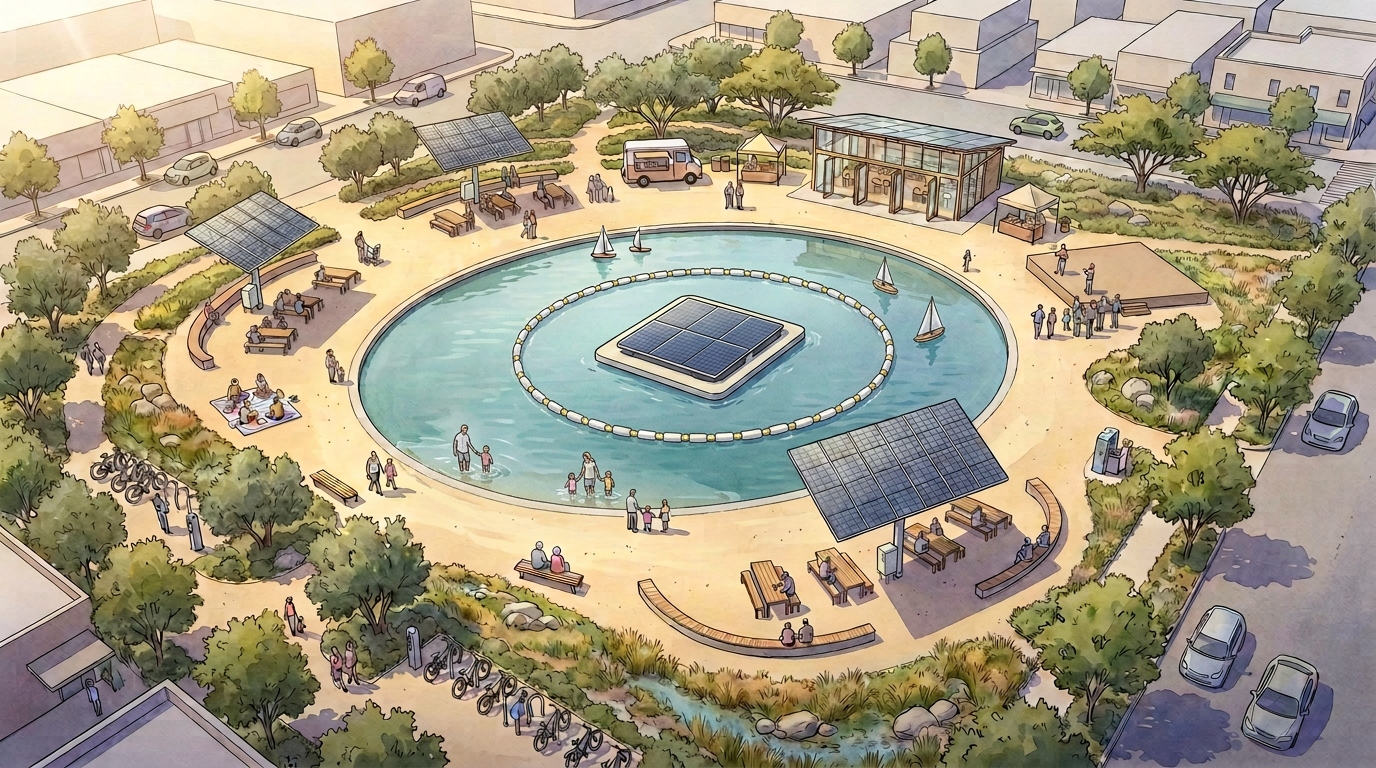
Reference illustration — one way a Communal Park anchor node can be built: dual-axis solar arrays provide generation and shade, a central pool doubles as a recreation amenity and water-purification asset, and the surrounding ring hosts mobility charging, a concession pavilion, and community gathering space.
Local generation behind the park's Energy Router, a water body for thermal exchange, and a shallow geothermal network feed the local supply band, lowering the Utility's blended procurement cost.
A climate-controlled public room, water dispensing and treatment, vehicle and bicycle charging, fiber, and vacuum waste collection give the Utility load to energize and bill before residential connections are complete.
Electricity and water services, mobility charging, concession rent, and public programming provide direct operating revenue plus non-rate income that a rate-only residential build does not have access to.
Shade, seating, play, gardens, food, events, and a flexible interior room make the underground DC network and its benefits visible to members before they are asked to pre-commit.
The park is established as the physical and social center before homes, workspaces, and shops are built — timed to energize alongside the first tranche of routers and meters, giving early members and financiers a visible, revenue-earning asset while the pre-commitment drive is underway.
An existing park or public site becomes the first NetEdison node when a street is opened, a pipe replaced, or a public building renovated — the lower-capital path into a Communal Park anchor, reusing public land and piggybacking on already-planned municipal works.
A small, local, not-for-profit electric utility built on the EnergyNet protocol — member-owned, member-controlled, and structured under cooperative utility law that already exists on both sides of the Atlantic.
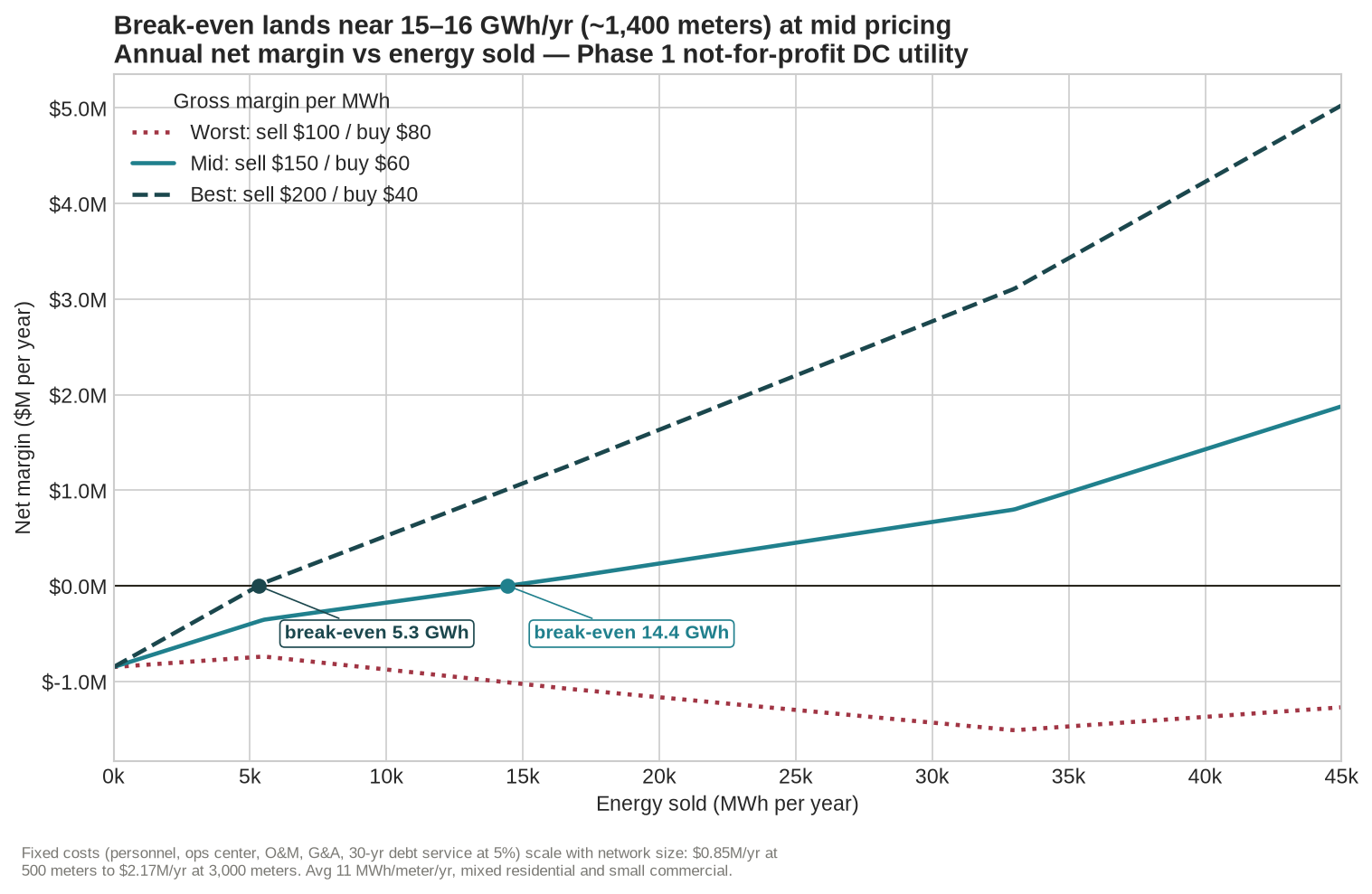
Phase 1 break-even analysis — annual net margin versus energy sold across the three gross-margin cases, with fixed costs scaling from roughly $0.85M/yr at 500 meters to $2.17M/yr at 3,000 meters.
The central finding of the Phase 1 plan: the fixed-cost floor — not the margin — determines viability. Below roughly 1,000 meters the Utility operates at a loss under almost any realistic pricing. A Communal Park changes that math by bringing forward a firm, meterable load and non-rate revenue (concession rent, mobility charging, programming) before most residential connections exist, following the infrastructure-park-buildings sequencing above.
Ninety years of precedent under the Rural Electrification Act of 1936, with federal tax exemption under IRC §501(c)(12) for member-owned electric cooperatives meeting the 85% member-income test.
Directive (EU) 2018/2001, Art. 22 (Renewable Energy Communities) and Directive (EU) 2019/944, Art. 16 (Citizen Energy Communities) expressly entitle member-controlled entities to own and operate distribution networks, share energy among members, and access all energy markets.
Developers, municipalities, landowners, and energy communities can register a Communal Park or Community Utility site with the NetEdison Registry, or reach the team directly to discuss a Phase 1 build.